Anthropogenic drivers of recent ebola and hantavirus outbreaks: A one health perspective
Zacharias Raptopoulos 1Aristos Aristodimou 2
1 Family Medicine Department, Limassol General Hospital, State Health Organization Services, Limassol, Cyprus
2 Internal Medicine Department, Limassol General Hospital, State Health Organization Services, Limassol, Cyprus
Abstract
Recent outbreaks of Ebola Virus Disease (EVD) and hantavirus infection have redrawn attention to the role of anthropogenic environmental change in the emergence of zoonotic diseases. Human activities, including deforestation, agricultural expansion, land-use modification and ecosystem degradation, have increasingly disrupted the interactions between wildlife reservoirs, domestic animals and humans, creating favourable conditions for pathogen spillover. In this commentary, we examine evidence linking these environmental drivers to the emergence and transmission of Ebola virus and hantaviruses, with particular emphasis on the effects of habitat alteration on wildlife ecology, viral evolution and host-pathogen interactions. We further discuss predictive models suggesting that, under current environmental and socioeconomic trajectories, the geographical risk of EVD will continue to expand. These observations underscore the urgent need to move beyond reactive outbreak response towards prevention by addressing the environmental determinants of disease emergence. We argue that the One Health framework, integrating human, animal and environmental health through coordinated multisectoral action, provides the most appropriate strategy for reducing the risk of future zoonotic outbreaks and strengthening global health security.
Keywords
ebola virus, hantavirus infections, ecosystem, global health, human activities, one-health-approach
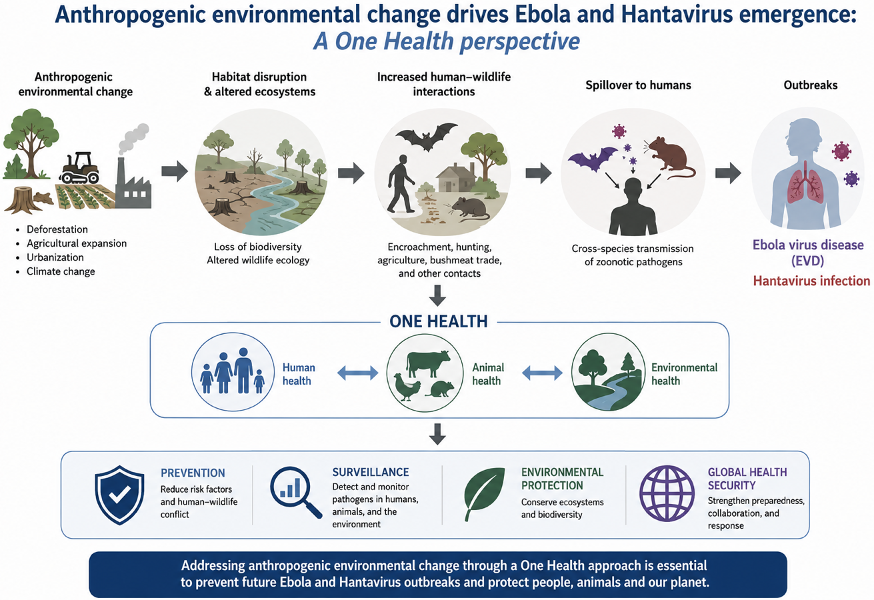
Graphical abstract
Introduction
Recent outbreaks of Ebola virus and hantavirus infections, occurring against the backdrop of accelerating anthropogenic environmental change, have renewed interest in the role of human activities in the emergence and persistence of zoonotic diseases [1], [2], [3]. Human-driven environmental changes, including climate change, land-use modification, deforestation, urbanization, and ecosystem degradation, have altered the interactions among humans, animals, and the environment, influencing the ecology and geographic distribution of infectious diseases [4], [5], [6], [7], [8], [9]. While outbreak-specific evidence for the most recent Ebola epidemic remains limited, studies of previous outbreaks caused by Zaire Ebola virus have consistently identified recurring anthropogenic and environmental factors—including population expansion, forest encroachment, climate variability, and deficiencies in water and sanitation infrastructure—that may facilitate zoonotic spillover and subsequent disease transmission [10]. Likewise, anthropogenic land-use change and agricultural expansion have been associated with an increased risk of human hantavirus infection through their effects on reservoir host ecology and opportunities for human exposure [11].
Collectively, these observations support the application of the One Health framework, which recognizes the interconnectedness of human, animal, and environmental health. Endorsed by international organizations such as the World Health Organization (WHO), the One Health approach provides a valuable framework for understanding the emergence and spread of zoonotic pathogens, including Ebola virus and hantaviruses [12]. In this commentary, we examine the potential contribution of anthropogenic environmental change to the recent Ebola virus and hantavirus outbreaks through the lens of One Health, drawing upon evidence from previous outbreaks and established ecological principles to discuss mechanisms that may underlie contemporary zoonotic emergence.
Anthropogenic drivers of Ebola and hantavirus outbreaks
Ebola virus disease (EVD) is caused by one of four pathogenic Ebolavirus species—Zaire, Sudan, Taï Forest and Bundibugyo—all associated with high case-fatality rates [13]. Although definitive reservoir identification remains elusive, Old World fruit bats are considered the most likely natural reservoirs or amplifying hosts [13]. Human infections typically result from zoonotic spillover following encroachment into forested habitats or contact with infected bushmeat [14]. Banik and Basu further argue that intensive farming facilitates viral mutation and reassortment, producing highly infective strains capable of efficient human-to-human transmission [14]. Moreover, approximately 31% of emerging zoonotic diseases, including Ebola virus disease, Nipah virus infection and severe acute respiratory syndrome (SARS), have been associated with land-use change driven by a 300% increase in agricultural expansion over the past 50 years [14]. Additional statistical modelling demonstrated that the probability of Ebola virus spillover in West and Central Africa increases significantly with deforestation, with every 5–10% reduction in forest cover approximately doubling the risk of outbreak occurrence [13], [14].
Hantavirus infection represents another important example of an environmentally driven zoonosis. The virus is maintained in asymptomatic rodent reservoirs and is transmitted to humans primarily through inhalation of aerosolized viral particles from contaminated rodent excreta [15]. Several studies have shown that deforestation and land-use intensification alter reservoir ecology and increase the prevalence of hantavirus infection [15]. Prist et al. describe the “dilution effect”, whereby reductions in non-reservoir species increase the relative abundance of competent reservoir hosts, thereby facilitating viral transmission [15]. Ecosystem-altering human activities not only increase opportunities for viral replication and transmission but may also influence hantavirus evolution. Holmes and Zhang argued that repeated host-switching events, rather than strict virus–host co-divergence, have been a major force shaping hantavirus evolution [16]. Habitat disturbance may further facilitate these evolutionary processes by increasing contact among reservoir species and creating greater opportunities for cross-species transmission [15].
Collectively, these examples demonstrate that anthropogenic environmental change not only increases opportunities for zoonotic spillover but also reshapes host–pathogen interactions, highlighting the need for integrated One Health strategies that address environmental degradation alongside infectious disease surveillance and preparedness.
The One Health framework for preventing zoonotic disease emergence
Both, EVD and hantavirus infection, have a major impact on human health and society. In addition to their high morbidity and mortality, these zoonoses impose a substantial economic burden on healthcare systems and public health infrastructure [14], [17]. Redding et al. estimated that, under current trajectories of environmental and socioeconomic change, the incidence of EVD will continue to increase [13]. More specifically, the authors predicted that by 2070 the maximum geographical area affected by EVD could expand from 3.45 million km² to 3.80 million km² [13]. These projections emphasize that, unless the underlying anthropogenic drivers of disease emergence are addressed, the burden of zoonotic diseases is likely to escalate in the coming decades.
The era in which emerging infectious diseases could be managed solely through clinical and public health interventions has long passed. The One Health framework, endorsed by the Centers for Disease Control and Prevention (CDC), recognizes the intrinsic interdependence of human, animal and environmental health and advocates an integrated, collaborative, multisectoral and transdisciplinary approach at the local, regional, national and global levels to prevent future zoonotic outbreaks [14], [17]. Importantly, responsibility for preventing emerging zoonoses should not rest exclusively with Ministries of Health but should be shared across the environmental, forestry and agricultural sectors [18]. Given the strong association between land-use change and zoonotic disease emergence, environmental policies should be regarded as an integral component of infectious disease prevention [14], [18]. Incorporating zoonotic disease risk into environmental impact assessments before large-scale deforestation, agricultural expansion or other ecosystem-altering activities could facilitate the identification of high-risk practices and inform mitigation strategies [18]. Likewise, strengthening surveillance programmes targeting wildlife reservoirs, particularly bats and rodents, together with advances in genomic surveillance, would improve the early detection of pathogens with zoonotic potential before widespread human transmission occurs [18]. Such proactive measures would shift the focus from responding to outbreaks toward preventing them by addressing their underlying anthropogenic drivers. As the recent Ebola and hantavirus outbreaks clearly demonstrate, the prevention of future pandemics depends not only on advances in medicine but also on the protection and sustainable management of the ecosystems upon which human health ultimately depends.
Conclusion
The recent Ebola Virus Disease and hantavirus outbreaks provide compelling evidence that anthropogenic environmental change is no longer a peripheral contributor to zoonotic disease emergence but one of its principal drivers. Deforestation, agricultural expansion and unsustainable land-use practices continue to reshape ecosystems, increase contact between humans and wildlife reservoirs, and facilitate pathogen spillover with potentially devastating public health consequences. As climate change and environmental degradation intensify, similar outbreaks are likely to become more frequent unless these upstream drivers are addressed. Future preparedness must therefore extend beyond improvements in diagnostics, therapeutics and outbreak surveillance to include policies that protect ecosystems, promote sustainable land management and integrate zoonotic disease risk into environmental decision-making. The One Health approach offers a scientifically grounded framework through which governments, public health authorities, environmental agencies and agricultural sectors can work collaboratively to mitigate the root causes of emerging infectious diseases. Ultimately, preventing the next pandemic will depend not only on advances in medicine but also on our ability to recognize that safeguarding environmental integrity is inseparable from protecting human health. The question is no longer whether anthropogenic environmental change influences the emergence of zoonotic diseases, but whether global health policy will evolve rapidly enough to address these environmental drivers before the next pandemic emerges.
Notes
Authors’ ORCIDs
- Raptopoulos Z: https://orcid.org/0009-0008-4798-9203
- Aristodimou A: https://orcid.org/0009-0003-6567-1999
Funding
None.
Competing interests
The authors declare that they have no competing interests.
AI usage
No artificial intelligence (AI) tools or AI-assisted technologies were used in the preparation, writing, editing, analysis, or revision of this manuscript. AI was used exclusively for the creation of the graphical abstract.
References
[1] World Meteorological Organization. Record-breaking heat spreads through Europe. Geneva: World Meteorological Organization; 2026 Jun 29 [cited 2026 Jul 1]. Available from: https://wmo.int/media/news/record-breaking-heat-spreads-through-europe[2] Centers for Disease Control and Prevention. 2026 hantavirus outbreak: testing for potential infection. Atlanta (GA): Centers for Disease Control and Prevention; 2026 Jun 26 [cited 2026 Jul 1]. Available from: https://www.cdc.gov/han/php/notices/han00529.html
[3] Centers for Disease Control and Prevention. Ebola disease outbreak in the Democratic Republic of the Congo. Atlanta (GA): Centers for Disease Control and Prevention; 2026 Jun 28 [cited 2026 Jul 1]. Available from: https://www.cdc.gov/han/php/notices/han00530.html
[4] Aristodimou A, Raptopoulos Z. A global warning in warm waters: the impact of climate change on the distribution and virulence of non-cholerae Vibrio species. Infect Dis (Lond). 2026 Mar; 58(3):371-4. DOI: 10.1080/23744235.2025.2612604
[5] Hansen JE, Kharecha P, Sato M, Tselioudis G, Kelly J, Bauer SE, Ruedy R, Jeong E, Jin Q, Rignot E, Velicogna I, Schoeberl MR, von Schuckmann K, Amponsem J, Cao J, Keskinen A, Li J, Pokela A. Global warming has accelerated: are the United Nations and the public well-informed? Environ Sci Policy Sustain Dev. 2025 Feb 3;67(1):6-44. DOI: 10.1080/00139157.2025.2434494
[6] Zhang Z, Qian Z, Chen M, Zhu R, Zhang F, Zhong T, Lin J, Ning L, Xie W, Creutzig F, Tang W, Liu L, Yang J, Pu Y, Cai W, Pu Y, Liu D, Yang H, Su H, Lu M, Li F, Cui X, Xie Z, Sheng T, Zhang K, Santi P, Tian L, Lü G, Yan J. Worldwide rooftop photovoltaic electricity generation may mitigate global warming. Nat Clim Change. 2025 Mar 7;15:393-402. DOI: 10.1038/s41558-025-02276-3
[7] Brkić Ž. Increasing water temperature of the largest freshwater lake on the Mediterranean islands as an indicator of global warming. Heliyon. 2023 Aug;9(8):e19248. DOI: 10.1016/j.heliyon.2023.e19248
[8] Pastor F, Valiente JA, Palau JL. Sea surface temperature in the Mediterranean: trends and spatial patterns (1982-2016). Pure Appl Geophys. 2018 Nov;175:4017-29. DOI: 10.1007/s00024-017-1739-z
[9] von Schuckmann K, Beltrami H, Boyer T, Cheng L, Cuesta-Valero FJ, Garcia-Garcia A, Gentine P, Ghent D, Haimberger L, Hollmann R, Kirchengast G, Mayer M, Palmer M, Seneviratne S, Shepherd A, Steiner A, Storto A, Straneo F, Tassone C. Heat stored in the Earth system: where does the energy go? Global Climate Observing System (GCOS); 2020 [cited 2026 Jul 1]. Available from: https://unfccc.int/sites/default/files/resource/2.%20GCOS%20Heat%20stored%20in%20the%20Earth%20system%20Where%20does%20the%20energy%20go.pdf
[10] Omoleke SA, Mohammed I, Saidu Y. Ebola viral disease in West Africa: a threat to global health, economy and political stability. J Public Health Afr. 2016 Aug 16;7(1):534. DOI: 10.4081/jphia.2016.534
[11] Moirano G, Botta A, Yang M, Mangeruga M, Murray K, Vineis P. Land-cover, land-use and human hantavirus infection risk: a systematic review. Pathog Glob Health. 2024 Jul;118(5):361-75. DOI: 10.1080/20477724.2023.2272097
[12] World Health Organization. WHO and France shift One Health vision to action with new high-impact initiatives. Geneva: World Health Organization; 2026 Apr 7 [cited 2026 Jul 1]. Available from: https://www.who.int/news/item/07-04-2026-who-and-france-shift-one-health-vision-to-action-with-new-high-impact-initiatives
[13] Redding DW, Atkinson PM, Cunningham AA, Lo Iacono G, Moses LM, Wood JLN, Jones KE. Impacts of environmental and socio-economic factors on emergence and epidemic potential of Ebola in Africa. Nat Commun. 2019 Oct 15;10:4531. DOI: 10.1038/s41467-019-12499-6
[14] Banik A, Basu S. Drivers and consequences of viral zoonoses: public health and economic perspectives. Zoonotic Dis. 2025 Nov;5(4):32. DOI: 10.3390/zoonoticdis5040032
[15] Prist PR, D'Andrea PS, Metzger JP. Landscape, climate and hantavirus cardiopulmonary syndrome outbreaks. EcoHealth. 2017 Jun;14(4):614-29. DOI: 10.1007/s10393-017-1255-8
[16] Holmes CE, Zhang YZ. The evolution and emergence of hantaviruses. Curr Opin Virol. 2015 Feb;10:27-33. DOI: 10.1016/j.coviro.2014.12.007
[17] Ramos-Nino ME, Chiem NT, Ramadass PVAK. Hantavirus emergence in a changing world: virology, pathogenesis, surveillance, and One Health preparedness. Microorganisms. 2026 Jun 13;14(6):1326. DOI: 10.3390/microorganisms14061326
[18] Cunningham AA, Daszak P, Wood JLN. One Health, emerging infectious diseases and wildlife: two decades of progress? Philos Trans R Soc Lond B Biol Sci. 2017 Jul 19;372:20160167. DOI: 10.1098/rstb.2016.0167