
[ACALES als Ergänzung zum deutschen Matrixtest in der klinischen Messroutine: Systematische Variation von Hintergrundgeräuschen und räumlicher Trennung]
Markus Meis 1,2Melanie A. Zokoll 1,2
Melanie Krueger 1,2
Alexandra Winkler 1,2,3
1 Hörzentrum Oldenburg gGmbH, Oldenburg, Germany
2 Cluster of Excellence “Hearing4all”, Carl von Ossietzky Universität Oldenburg, Oldenburg, Germany
3 Universitätsklinik für Hals-Nasen-Ohren-Heilkunde, Evangelisches Krankenhaus Oldenburg, Oldenburg, Germany
Zusammenfassung
Das Verfahren ACALES (Adaptive CAtegorical Listening Effort Scaling) zur Erfassung der Höranstrengung wurde hinsichtlich der Sensitivität ökologisch valider Messbedingungen als Ergänzung zum deutschen Matrixtest (Oldenburger Satztest, OLSA) untersucht. Ziel war es, Empfehlungen für den Einsatz in der klinischen Messroutine abzuleiten und die methodische Evidenzbasis für zukünftige Untersuchungen zu erweitern.
Das stationäre, sprachsimulierende Hintergrundgeräusch Olnoise des OLSA wurde mit zwei fluktuierenden Hintergrundgeräuschen verglichen. Hierzu wurden zum einen das vom International Collegium of Rehabilitative Audiology entwickelte ICRA5-250 und zum anderen der International Female Fluctuating Masker (IFFM) verwendet. Zusätzlich wurde die räumliche Trennung von Sprache und Hintergrundgeräusch systematisch variiert (S0N0, S0N90, S0N180, S45N-45). Insgesamt wurden 12 Messbedingungen bei 17 Cochlea-Implantat(CI)-Patienten untersucht.
Die Ergebnisse zeigten für ACALES im positiven, alltagsrelevanten SNR-Bereich signifikant geringere Höranstrengungswerte für das stationäre Hintergrundgeräusch Olnoise im Vergleich zu den fluktuierenden Hintergrundgeräuschen IFFM und ICRA5-250 (Olnoise < IFFM und ICRA5-250). Für den OLSA zeigten sich hingegen keine Effekte des verwendeten Hintergrundgeräuschs. Eine räumliche Trennung von Sprache und Hintergrundgeräusch führte zu einer signifikanten Reduktion der Höranstrengung (S45N-45, S0N90, S0N180 < S0N0), wobei die Effektstärken größer ausfielen als für den OLSA.
Insgesamt zeigte ACALES eine statistisch signifikante Sensitivität gegenüber ökologisch validen Messbedingungen. Zur Generalisierung der vorliegenden Ergebnisse sind jedoch Untersuchungen an größeren und heterogeneren klinischen Stichproben erforderlich.
Auf Grundlage der Ergebnisse wird empfohlen, ACALES ergänzend zu sprachaudiometrischen Untersuchungen in der klinischen Messroutine einzusetzen. Für CI-Träger wird zusätzlich zur leitlinienkonformen Messkonfiguration S0N0/Olnoise die Messkonditionen S45N-45 oder S0N90 mit dem Hintergrundgeräusch ICRA5-250 empfohlen.
Schlüsselwörter
ACALES, OLSA, ökologische Validität, ICRA5-250, IFFM, räumliche Trennung von Sprache und Hintergrundgeräusch
Introduction
For the diagnosis of hearing loss and to demonstrate the clinical-audiological efficacy of hearing aids, speech audiometric measurement methods under ideal, controlled laboratory conditions (“Efficacy”) are standard practice (HilfsM-RL; [1]). To evaluate treatment success in the field of cochlear implant (CI) fitting, the DGHNO-KHC specifies additional methods, such as questionnaires on quality of life and, as a supplement, methods assessing listening effort [2], to demonstrate effectiveness in everyday life. Methods that reflect patients’ everyday lives are becoming increasingly important from both a regulatory (“Real World Evidence,” RWE; MDR [3]) and legal perspective; see also the rulings of the Federal Social Court regarding reimbursement for hearing aids exceeding the fixed reimbursement amount [4].
Following the idea of everyday-relevant evaluations, Hey et al. [5] varied different measurement configurations for the German matrix test (Oldenburg Sentence Test, OLSA; [6]). In doing so, they systematically varied complex, multichannel, spatial configurations for the spatial separation of speech and background noise, as well as stationary versus fluctuating background noise. The goal was to evaluate different CI preprocessing strategies. For an ecologically valid but simplified measurement setup, the authors proposed a 2-channel measurement setup for clinical evaluations. In this setup, speech (S) comes from the frontal 0° direction and the fluctuating noise (N) ICRA5 [7] from the 90° direction (measurement condition S0N90).
Wu et al. [8] identified a range of approximately +5 to +10 dB for the signal-to-noise ratio (SNR) as typical, real-world, and relevant listening situations (“indoors crowd”/“home”). However, many studies have shown that the OLSA is less sensitive to demonstrating effects in the positive SNR range, e.g., [9], [10]. In addition, the effectiveness of hearing aid (HA) and CI care has increasingly been shown to be less fully represented by speech audiometric procedures alone [11].
To increase ecological validity in the range of positive SNR values and to use outcome tools beyond speech audiometry, questionnaires (Patient-Reported Outcome Measures; PROM) and Ecological Momentary Assessment (EMA, [12]) methods are worth considering. The method for measuring subjective listening effort, ACALES (Adaptive CAtegorical Listening Effort Scaling, [13]), is also a candidate for ecologically valid measurements and addresses the subjective, cognitive effort required to follow a conversation [10]. ACALES has the advantage that it uses the same stimuli as the OLSA with an equally adaptive procedure; a positive SNR range is also considered a priori in the analyses of effectiveness [13].
A number of studies on ACALES are now available in the field of clinical research. These include studies on implants—specifically audio/sound processors from the Vibrant Sound Bridge (VSB) and CI—such as [14], [15], and [16], in which effectiveness was demonstrated. However, due to the heterogeneity of the measurement setups and research questions, it is not possible to make reliable statements regarding sensitivity in relation to ecologically valid measurement setups (type of background noise and spatial separation of speech and background noise). The present study investigates this question.
Primary endpoints: ACALES is sensitive with respect to ecological measurement setups, specifically when comparing stationary (Olnoise) vs. fluctuating background noise (IFFM [17], ICRA5-250 [7]), as well as the spatial separation with the conditions S0N0 vs. S0N90, S0N180, and S45N-45. ACALES demonstrates at least comparable sensitivity relative to the OLSA.
Secondary endpoint: ACALES with ecologically valid measurement configurations can also be used reliably with CI patients in clinical measurement routine.
The goal is to provide recommendations for the measurement of ACALES in CI patients, while taking ecological validity into account; see also [5] for the OLSA.
Methods
Participants
A total of 17 CI users (8 female, 9 male) participated in the study; the mean age was M=65.2 years (range: 30–85 years). All participants wore a CI from Med-EL or Cochlear on at least one side. CI use was bimodal (N=9), unilateral (N=2), and bilateral (N=6); the mean duration of CI or hearing aid use was 23 years (range: 3–53 years).
Measurements
Test procedures: The German matrix tests OLSA [6], [18], [19] and ACALES [13] were used as test procedures. The OLSA measurements were conducted in an open-response format. Participants had to repeat random sentences structured according to the matrix principle (e.g., “Doris nahm zwölf rote Steine”; schema: Noun – Verb – Number – Attribute – Object). The responses were scored on a per-word basis according to standard practice to automatically determine the SNR for the next presentation, whereby the speech signal level was adjusted while the noise level remained unchanged. The goal was to determine the 50% speech recognition threshold (SRT50).
ACALES is also an adaptive method for controlling the SNR. Using a 13-point categorical scale ranging from ESCU (Effort Scale Categorical Units) 1=“no effort” to ESCU 13=“extremely effortful,” the subjectively perceived listening effort in a background noise situation could be classified. The SNR range was set to –16 to +16 dB with a fixed background noise level. The software applies a two-slope fit and outputs the values corresponding to ESCU 1, 7, and 13; for details, see [13]. The test material consisted of OLSA sentences [6], which were presented in background noise. For both methods, an initial training phase was conducted in accordance with the recommendations [13], [18].
Spatial configuration of speech and background noise: Based on the results of a study by Warkentin [20], the following measurements were conducted with regard to speech (S) and background noise (N): i) both frontal (S0N0), as well as spatially separated, in which case either ii) speech from the front and background noise directed to the ear fitted with the CI (+/–90°; hereafter S0N90), iii) speech from the front and background noise from behind (S0N180), and iv) speech and background noise from the front right and left (S45N-45).
Background noises: The respective background noise was presented continuously at 65 dB SPL. Before the first presentation, there was a 10-s lead-in period. Three different types of noise were used: i) the stationary standard noise from OLSA (Olnoise, [6]), ii) the International Female Fluctuating Masker (IFFM, [17]), and iii) the fluctuating ICRA5-250 noise [7].
The order of the measurement conditions was counterbalanced. All measurements were performed using the participant’s everyday devices without any changes to the fitting parameters.
Statistics
Statistical analysis was performed using IBM SPSS Statistics vers. 25. The significance level was set at α=0.05.
Not all variables followed a normal distribution, particularly the ACALES units. Because ANOVA is robust to violations of the normal distribution assumption, ANOVAs were performed to avoid numerous pairwise comparisons and to estimate an overall model. For OLSA and ACALES, separate repeated-measures ANOVAs were conducted according to the following scheme: spatial configuration (S0N0, S0N90, S0N180, S45N-45) × background noise (Olnoise, ICRA5-250, IFFM). When the sphericity assumption was violated, Greenhouse-Geisser (GG) degrees-of-freedom corrections were applied to determine significance and the effect size ηp2.
When a factor had a significant effect, Bonferroni-corrected post hoc tests were performed within the ANOVA. Means within the ANOVA are presented using “Estimated Marginal Means” (EMM).
Results
Speech intelligibility
The results of the SRT50 for the OLSA are shown in Figure 1 [Fig. 1] as box plots for the different spatial configurations and background noises.
Figure 1: SRT50 for the Oldenburg Sentence Test as a function of background noise and the spatial configuration of the speakers. The box plots show the median (–), the interquartile range (box length), and the whiskers (up to 1.5 times the interquartile range). Outliers are marked with an “o”. 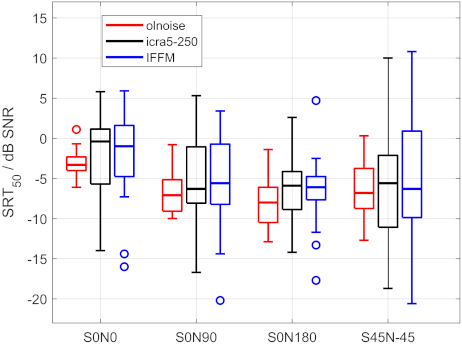
The effect of background noise was not significant with F(1.27/20.26)=2.24, p=0.15, ηp2=0.12, nor was the interaction between background noise and direction significant, with F(1.43/22.81)= 1.01, p=0.35, ηp2=0.06.
Spatial separation had a significant influence on SRT50, with F(1.4/22.87)=5.38, p=0.02; ηp2=0.25. The results of the post-hoc showed that a significantly worse threshold was measured for the S0N0 condition compared to the other three spatial configurations. The largest difference was observed between S0N0 vs. S0N180 with an EMM=–3.84 dB SNR (95% CI of the difference: –7.30 to –0.37).
ACALES
Figure 2 [Fig. 2] shows the results of the ACALES measurements. The analysis was not performed for all participants, but only for 15 participants. For one participant, measurements with the ICRA5-250 were not possible, and for another participant, measurement in the IFFM was only possible for the S0N180 presentation, as the “no effort” category was not reached in either case.
Figure 2: Results of the ACALES measurements (ESCU 1, 7, and 13) as a function of background noise and the spatial configuration of the speakers. The box plots show the median (–), the interquartile range (box length), and the whiskers (up to 1.5 times the interquartile range). Outliers are marked with an “o”.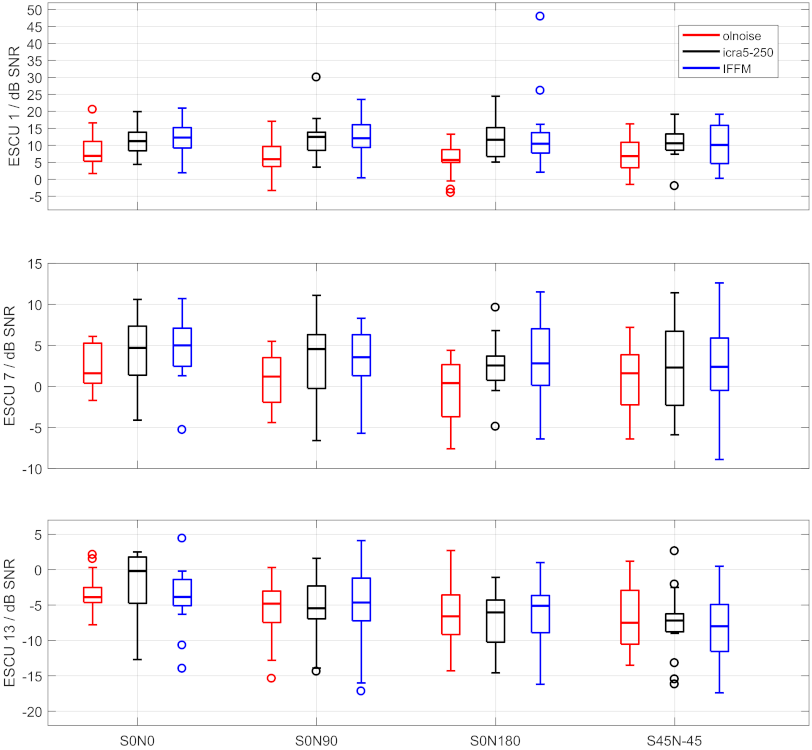
The ANOVAs described above were conducted separately for ESCUs 1, 7, and 13. The results showed that the background noise factor was significant for both ESCU 1 (F(2/28)=2.74, p=0.00, ηp2=0.48) and ESCU 7 (F(2/28)=10.52, p=0.00, ηp2=0.43). Post hoc tests indicated that the Olnoise background noise was perceived as significantly less effortful for ESCU 1 and 7 than ICRA5-250 and IFFM. The largest difference was observed in ESCU 1: Olnoise vs. ICRA5-250, EMM=–4.56 dB SNR (95% CI of the difference: –7.27 to –1.88).
For the factor spatial configuration, significant effects were observed for ESCU 7 (F(1.92/26.75)=4.91, p=0.02; ηp2=0.26) and ESCU 13 (F(3/42)=21.15, p=0.00; ηp2=0.60). Post hoc tests revealed significantly higher listening effort for the spatial presentation S0N0 compared to S0N90 and S0N180 in ESCU 7, and for S0N0>S0N90, S0N180, S45N-45, as well as S090>S45N-45 in ESCU 13. The greatest difference regarding spatial configuration was observed in ESCU 13: the spatial arrangement S0N0 was perceived as significantly more effortful than S45N-45, with EMM=4.61 (95% CI of the difference: 2.66 to 6.56).
The interaction between direction and background noise was not significant for ESCUs 1, 7, and 13 (all F<1.00, p>0.50).
Discussion
Overall, it was demonstrated that the ACALES method was sensitive with respect to both the spatial separation of the signals and the background noise used. Compared with the OLSA, at least equally large effect sizes were obtained; therefore, the primary endpoint was met. The secondary endpoint was achieved with some limitations: Two of 17 measurements could not be performed. The fluctuating noise applied to the CI ear apparently prevented the “no effort” category from being reached, so the measurements could not be completed.
With the OLSA, descriptively lower/better SNR values were observed for the stationary Olnoise compared to the fluctuating noise sources IFFM and ICRA5-250; however, these differences were not statistically significant. This effect can be explained by the fact that CI users cannot benefit from gap-listening in situations involving fluctuating background noise (see, for example, [21]).
For ACALES, on the other hand, the same direction of effect was observed, but the effects were statistically significant with ηp2=0.48 for ESCU 1 and ηp2=0.43 for ESCU 7, depending on the noise sources used.
For OLSA, significant differences occurred with effect sizes of ηp2=0.25 for the spatial configuration factor; however, the effect sizes are significantly smaller than those observed with ACALES for ESCU 13 in a comparable negative SNR range, where ηp2=0.60. For both methods, a consistent pattern of results was observed: spatial separation of speech and noise led to significantly better thresholds (see also Hey et al. [5]) and reduced listening effort.
In terms of recommendations for clinical measurements, ACALES data showed that the greatest differences in measurement conditions were observed between Olnoise vs. ICRA5-250, and between S0N0 vs. S45N-45/S0N90.
Overall, the results show that, in contrast to OLSA (SRT50), ACALES better covers the real-life, positive SNR range and is sensitive to ecologically valid measurement conditions. In line with Abdel-Latif & Meister [22], we regard ACALES as a complementary procedure to the OLSA for extending the range of demonstrated effectiveness to everyday situations.
The results must also be viewed in light of clear limitations. No conclusions can be drawn regarding the representativeness of the CI patients measured here or of other clinical patient groups. The results, as well as our recommendations, apply only to CI patients. Furthermore, the sample size was quite small, with 17 measurements and two dropouts. Large intraindividual and interindividual variability occurred in ACALES data, see also [16]. Therefore, the ACALES results should be viewed with caution.
This study did not report any evidence of the effectiveness of an intervention such as preprocessing or therapeutic effects; therefore, the clinical relevance of these data should be viewed with caution. However, initial studies suggest that intervention effects can be demonstrated using ACALES, e.g., [14], [15], [16].
Further studies are needed with larger and more diverse clinical samples, e.g., different indications or types of hearing devices, such as acoustical implants, bone anchoring hearing aids, or middle ear implants, to establish a measurement protocol of ACALES inside the clinical practice.
Recommendations for ACALES in clinical practice
- Use of ACALES in addition to OLSA in the classic S0N0 measurement setup with Olnoise (analogous to the German CI guideline, “S2k-Leitlinie Cochlea-Implantat Versorgung” [2]).
- Measurement conditions to address ecological validity: an additional 2-channel setup with S45N-45 or S0N90 with ICRA5-250 background noise, whereby the noise should be applied to the ear fitted with the hearing aid or CI being evaluated.
- Background noise level of 65 dB SPL for CI patients.
- Binaural measurements, speech audiometry and ACALES, also to enable comparison with questionnaires and measurements of real-life situations.
- Intraindividual measurements throughout the course of rehabilitation.
Notes
Conference presentation
This contribution was presented at the 28th Annual Conference of the German Society of Audiology and published as an abstract [23].
Ethics statement
The study was approved by the “Kommission für Forschungsfolgenabschätzung und Ethik” at the University of Oldenburg, effective July 31, 2025 (Drs. EK/2021/031-10).
Competing interests
The authors are employees of Hörzentrum Oldenburg gGmbH, which distributes the ACALES measurement method.
References
[1] Gemeinsamer Bundesausschuss. Richtlinie über die Verordnung von Hilfsmitteln in der vertragsärztlichen Versorgung – HilfsM-RL; in Kraft getreten am 16. Mai 2025. GBA; 2025.[2] Deutsche Gesellschaft für Hals-Nasen-Ohren-Heilkunde, Kopf- und Hals-Chirurgie e. V. (DGHNO-KHC), et al. S2k-Leitlinie Cochlea-Implantat Versorgung. Version 3.0. AWMF-Registernr. 017/071. Berlin: AWMF; 2020.
[3] Medical Device Regulation (MDR): Verordnung (EU) 2017/745 des Europäischen Parlaments und des Rates vom 5. April 2017 über Medizinprodukte. Amtsblatt der Europäischen Union. 2017;L 117:1-175.
[4] Bundessozialgericht (BSG). Verhandlung B 3 KR 13/23 R: Krankenversicherung - Hilfsmittelversorgung - Hörgerät - Überfestbetrag - Freiburger Einsilbertest. 2025 [last accessed 2026 Jun 19]. Available from: https://www.bsg.bund.de/SharedDocs/Verhandlungen/DE/2025/2025_06_12_B_03_KR_13_23_R.html
[5] Hey M, Mewes A, Hocke T. Sprachverstehen im Störschall – Überlegungen zur ökologisch validen Bewertung der Kommunikationsfähigkeit mit Cochleaimplantat [Speech comprehension in noise-considerations for ecologically valid assessment of communication skills ability with cochlear implants. German version]. HNO. 2022 Dec;70(12):861-9. DOI: 10.1007/s00106-022-01234-1
[6] Wagener K, Kühnel V, Kollmeier B. Entwicklung eines Satztests für die deutsche Sprache I: Design des Oldenburger Satztests. Z Audiol. 1999;38(1):4-15.
[7] Dreschler WA, Verschuure, H, Ludvigsen C, Westermann S. ICRA noises: Artificial noise signals with speech-like properties. Audiology. 2001;40(3):148-57. DOI: 10.3109/00206090109073110
[8] Wu YH, Stangl E, Chipara O, Hasan SS, Welhaven A, Oleson J. Characteristics of Real-World Signal to Noise Ratios and Speech Listening Situations of Older Adults With Mild to Moderate Hearing Loss. Ear Hear. 2018;39(2):293-304. DOI: 10.1097/AUD.0000000000000486
[9] Klink KB, Schulte M, Meis M. Measuring listening effort in the field of audiology - a literature review of methods (part 1). Z Audiol. 2011; 51(2):60-7.
[10] Krueger M, Schulte M, Zokoll MA, Wagener KC, Meis M, Brand T, Holube I. Relation Between Listening Effort and Speech Intelligibility in Noise. Am J Audiol. 2017 Oct;26(3S):378-92. DOI: 10.1044/2017_AJA-16-0136
[11] Lailach S, Lenz A, Zahnert T, Neudert M. Wertigkeit von Patient-Reported Outcome Measures zur Bewertung des Versorgungsvorteils der Sprachprozessorumversorgung bei Patient/-innen mit Cochleaimplantaten [Value of patient-reported outcome measures for evaluating the benefit of speech processor upgrading in patients with cochlear implants]. HNO. 2024 Jan;72(Suppl 1):25-32. DOI: 10.1007/s00106-023-01342-6
[12] Holube I, von Gablenz P, Bitzer J. Ecological Momentary Assessment in Hearing Research: Current State, Challenges, and Future Directions. Ear Hear. 2020;41 Suppl 1:79S-90S. DOI: 10.1097/AUD.0000000000000934
[13] Krueger M, Schulte M, Brand T, Holube I. Development of an adaptive scaling method for subjective listening effort. J Acoust Soc Am. 2017 Jun;141(6):4680. DOI: 10.1121/1.4986938
[14] Rahne T, Fröhlich L, Wagner L, Kropp MH, Müller A. Speech perception and hearing effort using a new active middle ear implant audio processor. Eur Arch Otorhinolaryngol. 2022 Oct;279(10):4667-75. DOI: 10.1007/s00405-021-07207-4
[15] Zokoll MA, Meis M, Wagener KC, Grober S, Radeloff A, Hessel H. Vorteile des direkten akustischen Streamens beim Telefonieren bimodal versorgter Hörsystemnutzer. GMS Z Audiol (Audiol Acoust). 2023;5:Doc03. DOI: 10.3205/zaud000029
[16] Wesarg T, Wiebe K, Galindo Guerreros JC, Arndt S, Aschendorff A, Voß B. Speech Understanding and Subjective Listening Effort in Noise With Different OTEs and Sound Processing Technologies. Otol Neurotol. 2024 Feb;45(2):e91-e101. DOI: 10.1097/MAO.0000000000004091
[17] Holube I. Speech intelligibility in fluctuating maskers. Proceedings of the International Symposium on Auditory and Audiological Research. 2011;(3):57-64.
[18] Wagener K, Brand T, Kollmeier B. Optimierung eines Satztests für die deutsche Sprache II. Z Audiol. 1999;38:44-56.
[19] Wagener K, Brand T, Kollmeier B. Evaluation eines Satztests für die deutsche Sprache III. Z Audiol. 1999;38:86-95.
[20] Warkentin L, Holube I, Winkler A, Denk F, Sankowsky-Rothe T, Blau M, Husstedt H. Verwendung von Sprachtests im Freifeld in Deutschland. GMS Z Audiol (Audiol Acoust). 2024;6:Doc09. DOI: 10.3205/zaud000044
[21] Wagner TM, Wagner L, Plontke SK, Rahne T. Enhancing Cochlear Implant Outcomes across Age Groups: The Interplay of Forward Focus and Advanced Combination Encoder Coding Strategies in Noisy Conditions. J Clin Med. 2024 Feb;13(5):1399. DOI: 10.3390/jcm13051399
[22] Abdel-Latif KHA, Meister H. Speech Recognition and Listening Effort in Cochlear Implant Recipients and Normal-Hearing Listeners. Front Neurosci. 2021;15:725412. DOI: 10.3389/fnins.2021.725412
[23] Krüger M, Meis M, Winkler A, Zokoll MA. ACALES als Messverfahren in der klinischen Routine. In: Deutsche Gesellschaft für Audiologie e. V., editor. 28. Jahrestagung der Deutschen Gesellschaft für Audiologie. Oldenburg, 04.-06.03.2026. Düsseldorf: German Medical Science GMS Publishing House; 2026. Doc149. DOI: 10.3205/26dga149